Who Was Sent Adrift and Never Was Seen Again
" data-medium-file="https://ottawow.files.wordpress.com/2014/02/hudsonstone-2a-2014.jpg?w=300" data-large-file="https://ottawow.files.wordpress.com/2014/02/hudsonstone-2a-2014.jpg?w=462" class="size-full wp-image-301" alt="A stone inscribed with "HH 1612 CAPTIVE" found near Chalk River in 1959 may hold the key to solving a 400 year mystery of what happened to the ill-fated explorer Henry Hudson. " src="https://ottawow.files.wordpress.com/2014/02/hudsonstone-2a-2014.jpg?w=620" srcset="https://ottawow.files.wordpress.com/2014/02/hudsonstone-2a-2014.jpg 462w, https://ottawow.files.wordpress.com/2014/02/hudsonstone-2a-2014.jpg?w=150 150w, https://ottawow.files.wordpress.com/2014/02/hudsonstone-2a-2014.jpg?w=300 300w" sizes="(max-width: 462px) 100vw, 462px">
A stone inscribed with "HH 1612 CAPTIVE" found near Chalk River may concord the cardinal to solving the 400 twelvemonth mystery of what happened to the ill-fated explorer Henry Hudson. (photo D.Pilgrim)
A new look at a 400 year old mystery.
Only 75kms away from where Champlain plainly lost his astrolabe in 1613, in the town of Chalk River, ON, there is a rock with carved markings that read "HH Captive 1612". Constitute in 1959 when a road worker re-paving Highway 17 came across it, this rock could help solve the mystery of what happened to the famous explorer Henry Hudson after his coiffure sent him adrift from his ship in a 1611 wildcat on James Bay. Does the carved "HH" stand for "Henry Hudson", held captive, a note left for someone to find and help him escape? Towns, bridges, rivers, bays, and retail stores are all named after him but he remains a mystery, a character lost in time with no last resting place as a landmark like the many places that display his name. The intrepid explorer Henry Hudson vanished into history, his legacy fading into the Canadian wilderness, but now in that location may be an answer.
HENRY HUDSON – Man of many places
On June 23, 1611, in an effort to find the Northwest Passage, a mutiny aboard his transport Discovery left Henry Hudson afloat on what is at present Hudson Bay, never to be heard from again. Before his mysterious disappearance this famous British explorer entered what is now New York state's Hudson River in 1609, with the river beingness named after him in 1900. He founded Manhattan for the Dutch who he was employed by at the time. Inbound New York City harbour, Hudson sailed 240 kilometres north on what the Native Americans called Muhheakantuck, now the Hudson River, exploring its shores all the way up to what is now Albany, NY.
" data-medium-file="https://ottawow.files.wordpress.com/2014/01/hudsonnyc.jpg?w=300" data-large-file="https://ottawow.files.wordpress.com/2014/01/hudsonnyc.jpg?w=525" class="wp-image-228" alt="A replica of Henry Hudson's 1609 ship "Half Moon" sails into New York City harbour during 2009 celebrations." src="https://ottawow.files.wordpress.com/2014/01/hudsonnyc.jpg?w=235&h=160" width="235" height="160" srcset="https://ottawow.files.wordpress.com/2014/01/hudsonnyc.jpg?w=235&h=160 235w, https://ottawow.files.wordpress.com/2014/01/hudsonnyc.jpg?w=470&h=320 470w, https://ottawow.files.wordpress.com/2014/01/hudsonnyc.jpg?w=150&h=102 150w, https://ottawow.files.wordpress.com/2014/01/hudsonnyc.jpg?w=300&h=204 300w" sizes="(max-width: 235px) 100vw, 235px">
A replica of Henry Hudson's 1609 ship "Half Moon" sails into New York City harbour during 2009 celebrations.
Too named later him is the huge saltwater bay, Hudson Bay, bordered by the provinces of Quebec, Ontario, Manitoba and Nunavut. The second-largest bay in the world, the bay connects to the Atlantic Body of water via the Hudson Strait, also named after him. The Hudson's Bay Company, the oldest commercial corporation in Northward America (in continuous operation for over 340 years) and one of the oldest in the world, too carries the explorer'southward name. A large cost bridge that connects Manhattan to the Bronx in New York City, the Henry Hudson Bridge was opened in 1936 near the site that Hudson first dropped anchor in 1609. The quaint tourist town of Hudson, NY is also named after Captain Hudson. Plainly this is someone of great importance to have then many prominent, historical landmarks named in his honor. Simply why has nobody ever tried to discover out what happened to him?
A few books accept been published about the disappearance of Henry Hudson, with many speculations fabricated near his death. Some say he was murdered on his ship and cast overboard past his mutinous crew, others say he was sent off his ship with his son and vii others in a pocket-sized gunkhole only to die floating across the icy arctic waters. Some other story states that Hudson, his son and the seven crew members loyal to him fabricated information technology to shore and joined a grouping of expanse natives where they lived out the remainder of their lives. Other legends have Hudson sailing dorsum to United kingdom of great britain and northern ireland, or joining a native tribe, fathering children with a a female tribe member and living out his days happily as a family man in the Canadian wilderness.
A startling clue discovered only a 2 hour drive west of Ottawa may now assist trace what actually happened to Henry Hudson.
AN ICY JOURNEY

Henry Hudson'due south map showing his 1610 arctic journey into Hudson's Bay.
In hopes of finding the Northwest Passage to the Orient, and with the bankroll of the Virginia Visitor and the British East Republic of india Company under the English flag, Hudson took the helm of his new ship, the Discovery in April 1610. A 70 ton send that was to canvas across the North Atlantic with a crew of 22 men, including his teenage son. Departing England in April, Hudson arrived in Iceland on May 11 where he continued towards the due south of Greenland rounding the southern tip in June. Hudson's cartography skills were very accurate as his his map of the voyage (scale nonetheless) compares well to a present day Google map of the area.

Hudson'south quite accurate 1610 map overlaid on a electric current Google map of the same areas.
Henry Hudson entered Hudson Bay in Baronial 1610 and continued along the eastern coast of the bay entering what is now James Bay. In a desperate search for the legendary passage to the Orient, Hudson zigzagged his way through James Bay in hopes of discovering the fabled passage. The icy grasp of the Arctic was before long to have concord of the Discovery and its crew. On Nov i, 1610, the Discovery sailed close to shore but by November 10 they were frozen in. With simply enough supplies to final the wintertime, there was not enough to get them back to England.
" data-medium-file="https://ottawow.files.wordpress.com/2014/01/hudsons-ship.jpg?w=300" data-large-file="https://ottawow.files.wordpress.com/2014/01/hudsons-ship.jpg?w=396" class="size-full wp-image-231" alt="Hudson's ship "discovery" trapped in James Bay ice November 1610." src="https://ottawow.files.wordpress.com/2014/01/hudsons-ship.jpg?w=620" srcset="https://ottawow.files.wordpress.com/2014/01/hudsons-ship.jpg 396w, https://ottawow.files.wordpress.com/2014/01/hudsons-ship.jpg?w=150 150w, https://ottawow.files.wordpress.com/2014/01/hudsons-ship.jpg?w=300 300w" sizes="(max-width: 396px) 100vw, 396px">
Hudson'southward ship "Discovery" trapped in James Bay ice November 1610.
Hudson started rationing nutrient which started a segmentation between the crew that was the kickoff of the end for Hudson. Hudson had a difficult time keeping club among his surly, sick, cold coiffure. With scurvy affecting many, members of the trek began to die and resentment towards the determined Captain grew. A plan to mutiny was formed and when the winter ended and the ship was free from the winter ice, they began the voyage domicile. The voyage did not get far before the wildcat occurred. Hudson was ambushed, along with his son, the ship's carpenter and those loyal to him. The transport's shallop (a 20-thirty foot boat with oars and a sail) was brought aslope the Discovery and the nine rope-bound men were loaded aboard the small boat with supplies, nutrient, tools and blankets.

A delineation of the mutiny by Francis Davignon.
The Discovery's turncoat coiffure released the shallop'south rope, setting Hudson and the 8 men adrift and the Discovery sailed abroad dorsum to England. The famous explorer and his companions were never heard from once again. No trace of Hudson or the 8 men have been ever been found to this day.
A THEORY
At present let's look at some facts well-nigh the state of affairs before nosotros settle on the theory that he just died and vanished into the icy waters of James Bay like the history books tell united states.
– Henry Hudson was an experienced sailor, explorer and cartographer who had successfully completed four arduous voyages to the New World.
– Hudson was adamant, tough and non one to give upward.
– Hudson had with him a carpenter aboard a boat equipped with oars and most likely a sail with supplies and equipment.
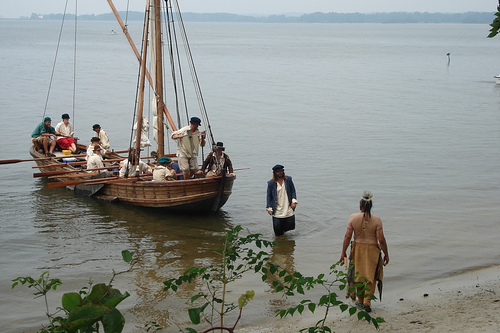
A typical early 1600's shallop, equipped with canvas and oars.
– Hudson and crew were at Nigh 75kms from the shore of James Bay when they were released in the shallop from Discovery.

Area where and Hudson was sent adrift in June 1611.
– It was June 23 when he was set adrift. The summer was just beginning.
A contempo book chosen "God'south Mercies: Rivalry, Betrayal and the Dream of Discovery", has writer Douglas Hunter describing how another famous explorer, Samuel De Champlain, found out that some Algonquins had enslaved an English youth. Champlain fabricated his first trip upwardly the Ottawa River in June 1613. Champlain travelled with Nicholas de Vignau, a human who had lived with the Algonquin people on the Upper Ottawa. Vignau told Champlain that he had visited the "Northern Ocean," or Hudson Bay/James Bay. Henry Hudson was there merely Two YEARS EARLIER. Champlain now was on the Ottawa River, hoping to visit this northern bounding main himself, the very ocean that Hudson was trying to escape from.

Champlain's astrolabe he allegedly dropped near Cobden, On in 1613 on his journeying upwardly the Ottawa River.
In fact, Champlain apparently dropped his astrolabe compass on the journey up the Ottawa River in an expanse that is now Cobden, ON. Information technology was unearthed in 1867 by a farmer's son and the Champlain astrolabe now rests in the Canadian Museum Of History. (Some question its authenticity)
Now this is where information technology gets interesting…
" data-medium-file="https://ottawow.files.wordpress.com/2014/02/hudsonstone-2-2014.jpg?w=258" data-large-file="https://ottawow.files.wordpress.com/2014/02/hudsonstone-2-2014.jpg?w=577" class="size-full wp-image-291" alt="The Hudson Stone as photographed on February 5th 2014. Inscribed with "HH 1612 CAPTIVE". No forensic archeologic studies have been done on the artifact. (Photo courtesy D.Pilgrim)" src="https://ottawow.files.wordpress.com/2014/02/hudsonstone-2-2014.jpg?w=620" srcset="https://ottawow.files.wordpress.com/2014/02/hudsonstone-2-2014.jpg 577w, https://ottawow.files.wordpress.com/2014/02/hudsonstone-2-2014.jpg?w=129 129w, https://ottawow.files.wordpress.com/2014/02/hudsonstone-2-2014.jpg?w=258 258w" sizes="(max-width: 577px) 100vw, 577px">
The Hudson Rock as photographed sitting in Chalk River on February 5th 2014. Inscribed with "HH 1612 Convict". To date, no forensic studies accept been done to verify the artifact. (Photo courtesy D.Pilgrim)
A stone was found by a construction worker while re-paving Highway 17 nigh Chalk River, ON in 1959 with unusual markings on it. Inscribed on the rock surface is "HH 1612 CAPTIVE". For reasons unknown there has never been an official archaeological confirmation of the rock'south authenticity. Some say it was improbable Henry Hudson could have made it as far south equally the Ottawa River. As well thought improbable was that Vikings made it to Canada 500 years before Columbus but now it is a proven fact they actually did. (L'Anse Aux Meadows, Newfoundland). Should we not study this stone that is supposedly insribed by Hudson and observe out if it really is genuine and the solve a 400 yr old mystery? Sitting in a pocket-size park in Chalk River, this rock could hold the key to what really happened after Hudson was sent adrift and terminate the mystery. Did Hudson and his men achieve the shore of James Bay and journey south just to be captured past the Algonquins with Samuel DeChamplain en route to save them? The plot thickens, so let's dig a footling deeper…
THE ESCAPE
At present let's take all those details mentioned in a higher place into consideration for a moment. What if Hudson and his men after beingness sent afloat pulled themselves together and rowed and/or sailed their shallop the 75kms to the shore of James Bay? A "shallop" is a xx-xxx vessel equipped with oars and a sail. In fact, in 1608,Captain John Smith and 14 English colonists set out from Jamestownin a 30-footshallop to explore and map the Chesapeake Bay. They traveledover 1,700 miles in three months. Hudson and his crew were cast off from Discovery in an identical type of gunkhole. They were released in their equipped shallop near the tip of James Bay, close to a number of rivers that enter the area, almost notably the Harricana River. This 533km long river was get-go used past the Algonquins as a river road and its name originates from the Algonquin discussion Nanikana, meaning "the master way". The Algonquins also use the name Inikana, meaning "river route". A segment of the river was called Wajaha Sibi, which means "river to the bay"…James Bay.
At present let's say Hudson makes his way to the Harricana River and continues southward on it. Information technology'south summer, they accept some equipment and a carpenter to way shelters, hunt for food and survive during the warm months of summer. Completely feasible the shallop could make its way south along the Harricana River. Now it is a fact this river is likewise used by the Algonquins who use information technology as a "main style" and a "river to the bay" as previously mentioned.
What if Hudson and his men are captured by the Algonquins and taken south through the Harricana River arrangement, over a 10km portage at Lac Mourier where the Harricana begins/ends and connects to Lac Simard where the Ottawa River begins/ends? Now on the Ottawa River, Hudson and whoever has survived along with him are traveling south with the Algonquins. Word spreads that "white men" (remember how Samuel De Champlain institute out that some Algonquins had enslaved an English language youth?) are captive and are making their style south along the Ottawa River.
.

Hudson, now captive, a year afterward his being abandoned in the shallop in 1611, has arrived near Deep River in 1612 with the Algonquins. The timeline makes sense. Traveling the Harricana River from James Bay downward the Ottawa River to Deep River would most probable accept a few months putting Hudson into 1612. In a desperate try to signal any possible rescuers of his dire state of affairs he carves into a rock "HH 1612 Convict", which remained there until information technology was discovered in 1959.

Samuel Champlain is making his style northward up the Ottawa River at about the same time, allegedly dropping his astrolabe only a mere 75kms south of the Hudson Stone in 1613. Did these ii famous explorers unknowingly cantankerous paths traveling in contrary directions along the Ottawa River? Hudson in Deep River, convict with the Algonquins in 1612, and Champlain there simply a few months later on in roughly the same place?

Approximate area where the Hudson Rock was recovered during re-paving of Highway 17 in 1959.
Perhaps past the fourth dimension Champlain heard that the Algonquins had enslaved an English youth (most likely Hudson's teenage son), Henry Hudson was dead, since Champlain was exploring the Ottawa River in 1613, and Hudson's desperate carving was made a twelvemonth earlier in 1612. Did the Algonquins impale him or did he die of illness after the carving was made in 1612 with simply his son surviving out of the 9 men originally set adrift? Perhaps the remains of Henry Hudson prevarication buried somewhere betwixt his carved message in Chalk River and Ottawa, narrowly missed by Champlain on his road in the other direction trying to find the northern sea where Hudson had originally started his fateful journey. Two famous explorers crossing paths, one trying to escape the cold, icy of waters of the arctic, the other trying to observe it.
We may never know what actually happened to Henry Hudson, his son or his loyal coiffure, and until we report the Hudson Stone in greater particular, nosotros can only imagine how the final days played out for the explorer whose name adorns some of North America's about notable landmarks.
SOURCES
http://en.wikipedia.org/wiki/Henry_Hudson
http://world wide web.ianchadwick.com/hudson/hudson_05.htm
http://www.findingdulcinea.com/news/on-this-twenty-four hour period/May-June-08/On-this-Twenty-four hours–Henry-Hudson-Set-Adrift-by-Mutineers.html
http://getawaytips.azcentral.com/landmarks-named-after-henry-hudson-3000.html
https://suite101.com/a/mysterious-disappearance-of-henry-hudson-a174487
http://books.google.ca/books?id=YGFLAQ-Cu6sC&pg=PA68&lpg=PA68&dq=henry+hudson+stone&source=bl&ots=TK8-_veGQM&sig=1Q81TfGClWN1yn8n9afB6AK0okE&hl=en&sa=Ten&ei=l7rqUpi9D_LNsQT-_oCwBQ&ved=0CGMQ6AEwCw#5=onepage&q=henry%20hudson%20stone&f=false
http://www.theglobeandmail.com/arts/hudson-at-bay/article1344733/
http://intheboatshed.net/2007/05/22/a-400-twelvemonth-former-shallop-rebuilt/
Source: https://ottawarewind.com/2014/02/06/finding-henry-did-henry-hudson-spend-his-last-days-in-the-ottawa-valley/
0 Response to "Who Was Sent Adrift and Never Was Seen Again"
Post a Comment